




Evodia Rutaecarpa Extract vs Isolated Evodiamine Alkaloid
I field emails about this exact mix-up almost every week. A procurement manager asks for a quote on "Evodia extract" when their R&D team actually needs pure Evodiamine for a thermogenic capsule. Both start from the exact same unripe fruit, but on the factory floor, they handle entirely differently. Let's break down the actual purity, dosing, and HPLC testing differences so you don't buy the wrong drum.
What Actually is Crude Evodia Extract?
When you buy a standard Evodia extract, you are essentially getting a basic solvent wash. The factory grinds up the unripe fruit, runs it through water or ethanol, and spray-dries whatever comes out. You end up with a broad mix of alkaloids, sticky plant waxes, and residual fibers.
The Spec: Usually sold as a 10:1 or 20:1 ratio extract. Actual Evodiamine levels swing wildly anywhere from 2% to 10%.
The Makeup: It's crowded. You get Evodiamine, but it's buried under Rutaecarpine, Evocarpine, and heavy flavonoids.
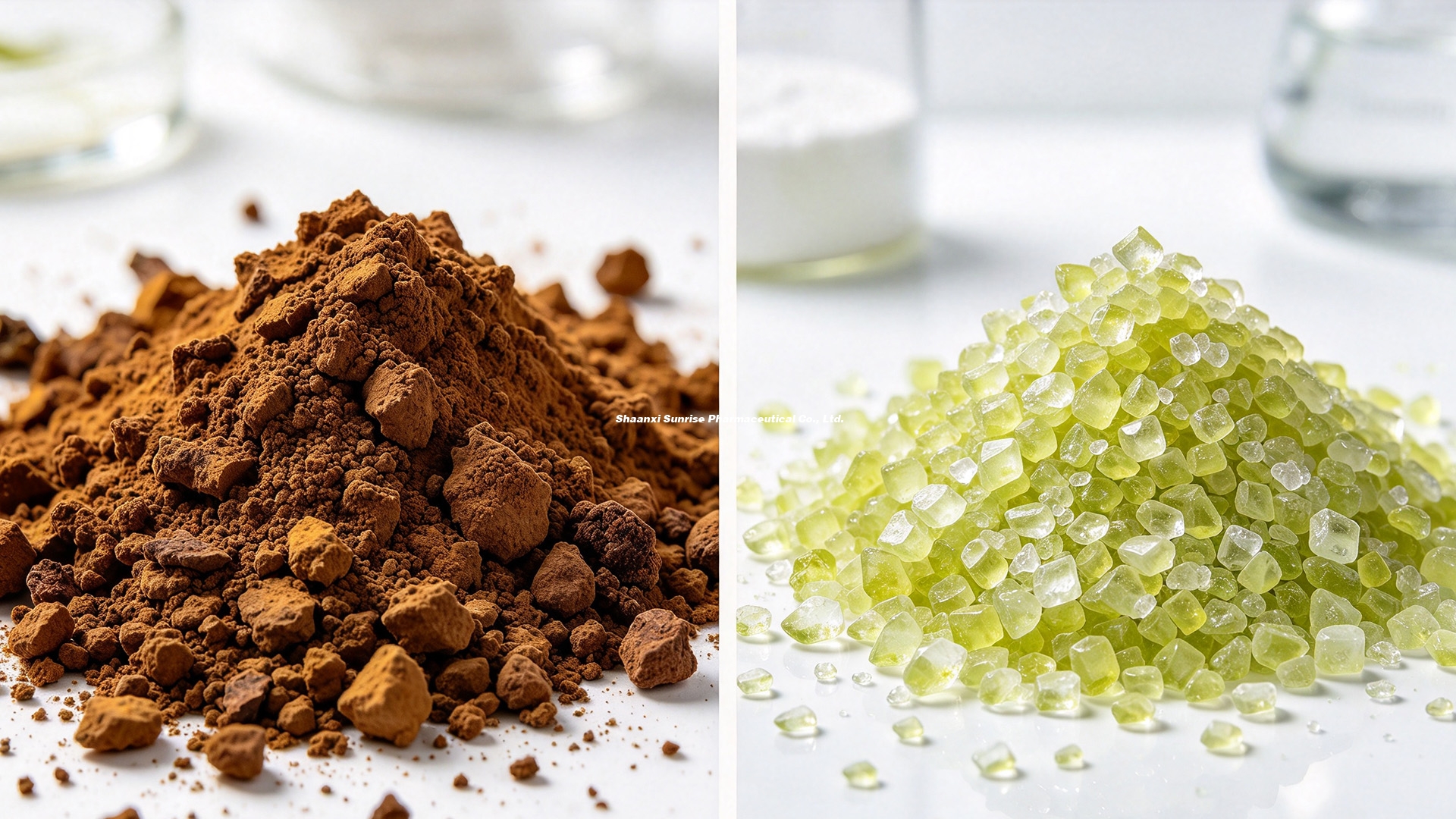
The Sensory Profile: It's a dark brown powder that smells pungent and tastes incredibly bitter. Flavor chemists hate it.
The Lab Test: Most suppliers run a cheap UV spectrophotometry test, not a precise HPLC scan.
Crude extracts are fine if you're building a cheap, multi-herb wellness blend where exact alkaloid dosing isn't critical. The fatal flaw is batch variation—your active content will fluctuate based on the harvest season and the extraction run.
The 98% Isolated Alkaloid Reality
This is where heavy chemistry takes over. To get isolated Evodiamine, we take that crude extract and push it through aggressive, repeated crystallization and membrane separation cycles. We strip away the Rutaecarpine and the plant trash until only the target molecule is left standing.
The Spec: A locked-in ≥ 98.0% Evodiamine baseline, proven against reference standards via HPLC.
The Makeup: It is practically a single-molecule ingredient. The other alkaloids are reduced to trace background noise.
The Sensory Profile: An off-white to pale yellowish-green crystalline powder with barely any odor.
The Solubility: Strictly lipophilic. It hates water and belongs exclusively in dry capsules or softgels.
Brands use the 98% isolation when they cannot afford dosing errors. If a thermogenic formula calls for exactly 30mg of Evodiamine, this is the only raw material that hits the mark consistently.
Shop-Floor Comparison Table
| Formulation Metric | Crude Evodia Extract | Isolated 98% Evodiamine |
|---|---|---|
| Actual Evodiamine Content | 2% – 10% (Massive batch-to-batch swings) | ≥ 98% (Strictly locked in) |
| Rutaecarpine Presence | High. Co-extracts with the rest of the plant. | Trace amounts only. Purified out. |
| Sensory Profile | Brown, sticky, heavily bitter, pungent. | Pale, dry, highly flowable, faint odor. |
| Dosing Precision | Guesswork. Hard to standardize the active hit. | Pinpoint. Exact milligram dosing. |
| Best Formulation Fit | Low-dose, broad-spectrum botanical blends. | Thermogenic capsules, sports nutrition stacks. |
| QA Testing Method | Usually cheap UV spectrophotometry. | Mandatory HPLC verification. |
Which One Does Your Formula Need?
Stick with crude Evodia extract if:
Your product is a general wellness blend relying on a broad botanical profile rather than a single active hit.
You don't need a legally defensible, fixed Evodiamine concentration on your label.
Your R&D team can handle wide batch variability and intense flavor-masking challenges.
Upgrade to isolated 98% Evodiamine if:
You are building a non-stimulant thermogenic formula that requires an exact milligram payload.
Your contract manufacturer needs a dry, free-flowing powder that won't jam the encapsulation machines.
You want to eliminate the nasty, bitter botanical aftertaste.
Your compliance team demands a full HPLC chromatogram and strict residual solvent reports.
If you need the deeper technical specs on the 98% purified grade, check out our companion guide: Bulk Evodiamine 98% Powder: A Sourcing Guide for Formulators.
Questions From the Procurement Desk
Can I just swap crude extract into my 98% Evodiamine capsule formula?
Absolutely not. Because the crude extract has completely unpredictable alkaloid levels, your active payload will crash. Plus, you'd have to pack so much crude powder into the capsule to hit your target dose that you wouldn't have room for any other ingredients.
What is Rutaecarpine, and why do you remove it?
Rutaecarpine is a sister alkaloid found in the Evodia fruit. In crude extracts, it rides shotgun with Evodiamine. We run aggressive isolation cycles to strip it out because brands formulating thermogenics want the pure metabolic action of Evodiamine without interference from other compounds.
Don't crude extracts come with a COA too?
They do, but look closely at the testing method. Most crude extracts are tested via UV spectrophotometry, which notoriously overestimates the alkaloid count by measuring all plant compounds that absorb light at that wavelength. That's why we only use HPLC for the 98% isolation.
Do you manufacture both grades?
Yes. We supply both the crude extracts and the HPLC-verified 98% isolates to the B2B market. Just tell our procurement team what your formulation requires, and we'll send the matching COA and lab samples.